
How to Stop Period Leaks at Night for Good

The fastest fix for period leaks at night: switch to a higher-absorbency overnight product, position it correctly before bed, and put a waterproof layer between you and your mattress. That three-part move handles most leaks before they start.
Tonight’s quick checklist:
- Change your product right before you get into bed, not an hour earlier
- Use an overnight pad, menstrual cup, or period underwear rated for heavy flow
- Add a backup layer (period underwear over a cup, or a pad inside period underwear)
- Place a folded towel or waterproof mattress protector under your hips
- Keep spare bottoms and a wet bag on your nightstand so a leak doesn’t become a crisis
That’s the short version. The rest of this guide explains why leaks happen at night, which products hold up best, and exactly what to do if you wake up to a mess.
Key Takeaways
Stopping period leaks at night comes down to three moves: use a higher-capacity overnight product, add a backup layer, and protect your mattress before you get into bed.
| Point | Details |
|---|---|
| Change right before bed | Swap your product immediately before sleep, not an hour earlier, to maximize overnight capacity. |
| Layer for heavy nights | Pair a menstrual cup or overnight pad with period underwear for double protection on heavy flow nights. |
| Protect the mattress | A waterproof mattress protector or folded towel under your hips prevents stains from reaching the mattress. |
| Know the tampon limit | Tampons must be changed within eight hours; use a cup or period underwear if you sleep longer. |
| Sweeteebeauty for overnight wear | Sweeteebeauty’s heavy-flow and postpartum period underwear styles are built to hold through a full night’s sleep, alone or as a backup layer. |
Table of Contents
- Why are period leaks at night more likely than during the day?
- Which overnight products actually hold up while you sleep?
- How to position products and set up your sleep to reduce back leaks
- How to protect your bedding and remove blood stains fast
- What to do before bed and if you wake up to a leak
- How do you choose the right absorbency, and when should you see a doctor?
- How Sweeteebeauty’s multilayer period underwear is built for overnight protection
- What actually works when you stop overthinking it
- Sweeteebeauty period underwear for overnight protection
- Sources
Why are period leaks at night more likely than during the day?
Gravity stops working for you the moment you lie down. During the day, blood flows downward and your pad or tampon catches it in a predictable direction. Horizontal, that flow shifts toward your back or sides depending on how you’re positioned, and a product designed to catch downward flow can miss entirely.

When you’re on your back, blood pools near the base of your spine. That’s where the morning gush comes from: blood that collected overnight releases all at once when you stand up. Side sleeping sends fluid toward whichever hip is lower, which is why a pad with wings on only the front and back can leak out the side.
Tossing and turning makes it worse. A pad shifts. A tampon that was placed correctly at 10 PM may be sitting at the wrong angle by 2 AM. PMS and menstrual symptoms already disrupt sleep quality, so you’re more likely to move around restlessly during the nights you need protection most. Less sleep, more movement, more displacement.
The third factor is time. You wear a product for 7–9 hours straight without changing it. Even a high-capacity pad or tampon has limits, and a full product at 3 AM with no one awake to change it is a leak waiting to happen. Choosing a product with enough capacity for your full sleep window is the single most controllable variable.
Which overnight products actually hold up while you sleep?
Overnight pads
Overnight pads (sometimes called maxi pads) are longer and wider than daytime pads, with extra coverage toward the back. They’re the most accessible option and require no insertion. Wings help anchor them to underwear, which matters a lot when you’re moving in your sleep.
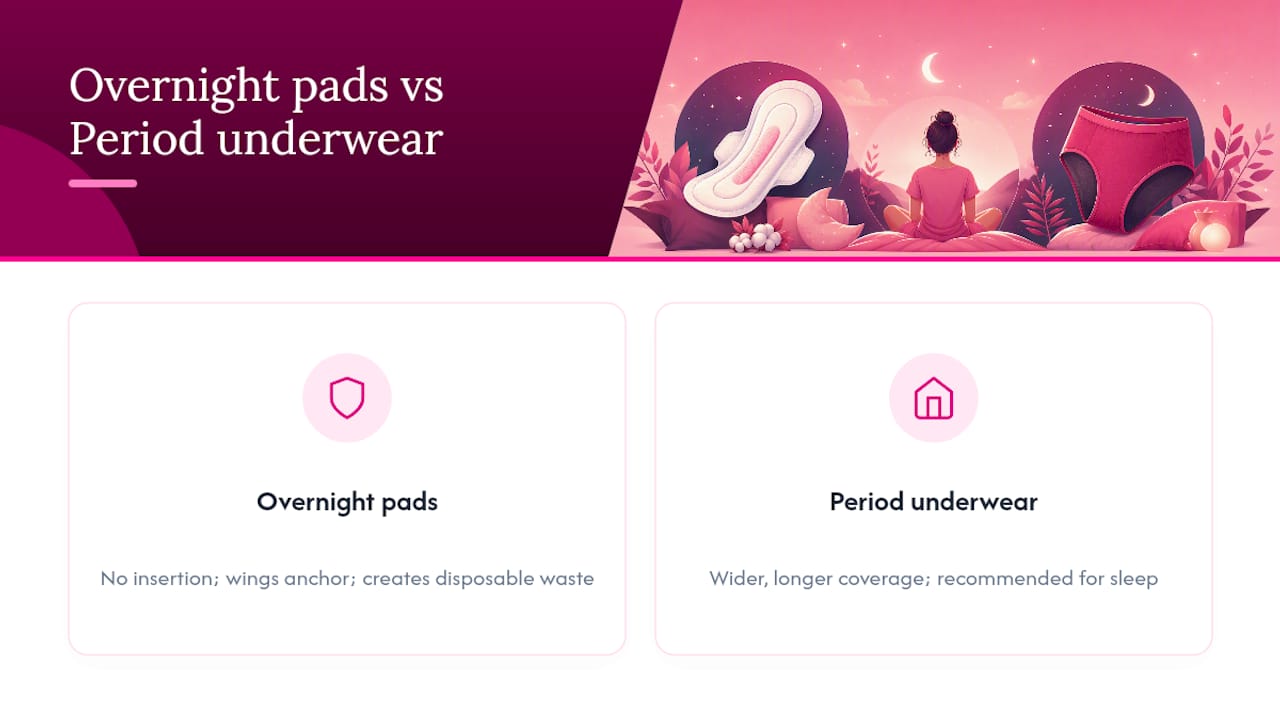
Pros: Easy to use, widely available, no insertion required, good back coverage. Cons: Can bunch or shift if underwear is loose; not ideal for stomach sleepers; generates disposable waste.
Overnight pads and period underwear are among the most recommended options for sleep because their wider, longer coverage accounts for the directional shift that happens when you lie down.
Tampons
Tampons work overnight for lighter flow nights, but the safety rule is firm: no tampon should be worn longer than about eight hours. Change right before bed and immediately when you wake up. If you sleep longer than eight hours regularly, a tampon alone is not a safe overnight choice.
Pros: Comfortable, no external bulk, good for active sleepers. Cons: Hard eight-hour limit, leak risk if flow is heavy, requires pairing with backup protection for longer sleep.
Menstrual cups and discs
Menstrual cups can offer higher capacity and longer wear times than tampons for many users, but correct placement and a proper seal are non-negotiable. A cup that’s not fully open or seated too low will leak regardless of its capacity. Discs sit differently (at the cervix rather than in the vaginal canal) and can work well for back sleepers.
Pros: High capacity, up to 12-hour wear for some users, reusable, no odor. Cons: Learning curve for insertion and seal, not ideal for beginners on a heavy night, still benefits from backup underwear.
Period underwear
Period underwear uses a multilayer fabric system to absorb flow directly, with no insert required. Absorbency levels range from light to heavy, and some styles are designed specifically for overnight use with extra coverage in the back panel. They work as a standalone option for moderate flow or as a reliable backup layer over a cup or tampon.
Pros: No shifting, no wings to unstick, comfortable for all sleep positions, reusable. Cons: Needs washing between uses, higher upfront cost than disposables.
Combining products
Pairing products is the most effective strategy for heavy nights. A menstrual cup plus period underwear covers both internal capacity and any external overflow. A heavy overnight pad inside period underwear adds a second absorption layer and keeps the pad from shifting. This layered approach is what most practical period guides converge on for very heavy flow or unpredictable nights.
How to position products and set up your sleep to reduce back leaks
Getting the product in place correctly before bed matters as much as which product you choose.
- Pad placement: Center the pad front-to-back in your underwear, then press the wings firmly underneath. For side sleepers, shift the pad slightly toward the back of the underwear so the rear coverage extends further.
- Tampon insertion: Insert fully so the base sits just inside the vaginal opening. A tampon that’s too low will leak around the sides.
- Cup seating: Insert, then rotate the cup a full turn and run a finger around the rim to confirm it has opened completely. A flat spot means the seal isn’t formed.
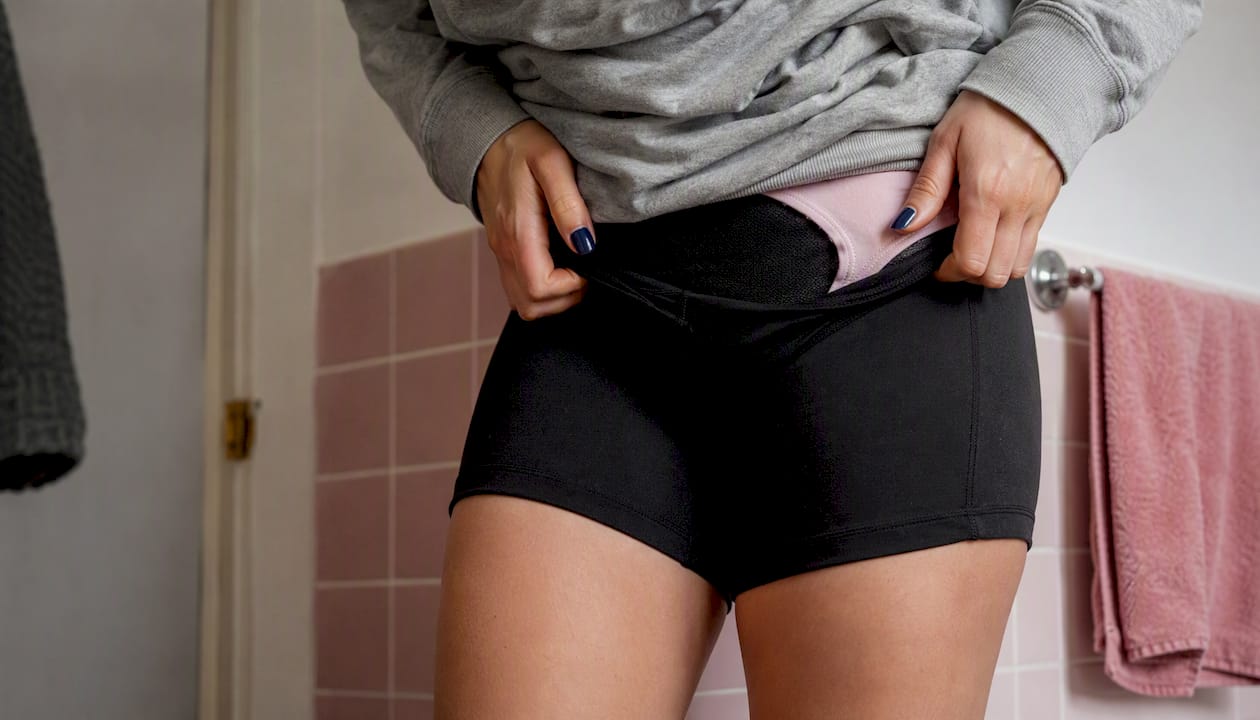
- Period underwear fit: Pull them up snugly so the gusset sits flush against your body with no gaps at the leg openings. Loose underwear = gaps = leaks.
Sleep position: Side sleeping in a loose fetal position tends to keep fluid centered and reduces back pooling. Placing a pillow between your knees supports your hips and reduces the rolling that displaces products. Stomach sleeping is the hardest position for most products to handle because it pushes fluid toward the front, where coverage is usually thinnest.
Pro Tip: If you toss and turn, wear fitted pajama bottoms or bike shorts over your period underwear. The compression keeps everything in place and adds a physical barrier if a leak does happen.
There’s no single position that works for everyone. Sleep comfort improvements like pillow support and side sleeping reduce tossing and turning, which in turn reduces product displacement. Try the fetal position first, but don’t stress if you wake up in a different one.
How to protect your bedding and remove blood stains fast
Bed protection options
- A folded dark towel under your hips: free, works immediately, easy to wash
- A waterproof mattress protector: the best long-term investment, protects the mattress itself
- Disposable underpads (also called chux pads): useful for travel or sleepovers
- Dark-colored or dedicated “period sheets” that you don’t worry about staining
Removing blood stains step by step
Fresh stains are far easier to treat than set-in ones. Cold water and enzymatic cleaners are the standard approach; hot water sets the stain permanently, so avoid it until the blood is fully out.
- Rinse immediately with cold water. Run cold water through the back of the fabric to push the stain out rather than deeper in.
- Apply an enzymatic pre-treater. Products like Zout, Biz, or any enzyme-based laundry spray break down the proteins in blood. Let it sit for 10–15 minutes.
- Wash in cold water. Check the stain before drying. Heat from a dryer will set any remaining stain permanently.
- For set-in stains: Soak in cold water with oxygen-based bleach (OxiClean works well on white or light fabrics). For dark fabrics, stick to enzyme cleaners.
- Delicate fabrics: Hand wash in cold water with a small amount of dish soap or enzyme cleaner. Skip the dryer entirely.
Pro Tip: Keep a small spray bottle of diluted enzyme cleaner on your nightstand during your period. Treating a stain within the first few minutes makes a significant difference.
For mattress stains, blot (don’t rub) with cold water and enzyme cleaner, then press a dry towel over the spot to absorb moisture. Let it air dry completely before putting sheets back on.
What to do before bed and if you wake up to a leak
Pre-bed routine
- Change your product right before getting into bed, even if you changed it an hour ago.
- If using a cup or tampon, add period underwear as a backup layer.
- Put a waterproof layer (towel or mattress protector) under your hips.
- Set spare pajama bottoms and clean underwear on your nightstand or nearby chair.
- Keep a small wet bag and travel-sized enzyme spray within reach.
Changing right before bed and doubling up on protection are among the most consistently recommended steps for reducing overnight leaks.
If you wake up to a leak
- Stay calm and move carefully to avoid spreading the stain.
- Remove soiled clothing and set it in the sink or a wet bag immediately.
- Rinse clothing in cold water right away.
- Blot the mattress or sheets with a cold, damp cloth to prevent the stain from setting.
- Change into your spare bottoms and replace your product before going back to sleep.
- Deal with the full stain removal in the morning using the steps above.
For sleepovers or travel: Pack a discreet wet bag for soiled items, a spare pair of bottoms, and a travel-sized enzyme spray. Period underwear is especially practical here because it’s a single item that handles both protection and backup without extra bulk.
How do you choose the right absorbency, and when should you see a doctor?
Match your product to your actual flow, not your best-case scenario.
- Light flow: A regular tampon or light-absorbency period underwear is usually enough overnight.
- Moderate flow: An overnight pad or moderate-absorbency period underwear, changed right before bed.
- Heavy flow: A heavy overnight pad plus period underwear as backup, or a menstrual cup plus period underwear.
- Very heavy or unpredictable flow: Cup plus heavy-absorbency period underwear, with a mattress protector in place.
The tampon rule applies regardless of flow: eight hours maximum, no exceptions. Change immediately before bed and immediately upon waking. If your sleep window is longer than eight hours, use a cup or period underwear instead.
When to see a clinician: Soaking through a pad or tampon in under an hour, passing large clots regularly, or waking up to soaked bedding despite using maximum-absorbency products are signs worth discussing with a healthcare provider. Sudden heavy bleeding, dizziness, or fatigue alongside heavy flow also merit prompt evaluation. Medical reviews recommend evaluation when bleeding is unusually heavy or prolonged — don’t wait it out if something feels off.
One more comfort note: if menstrual cramps are disrupting your sleep and causing you to move more, magnesium supplementation has evidence-backed guidance for some PMS-related symptoms, including cramps. Talk to your provider about whether it’s appropriate for you, since better sleep means less tossing and less product displacement.
How Sweeteebeauty’s multilayer period underwear is built for overnight protection
Sweeteebeauty’s period underwear uses a multilayer construction specifically designed to handle the directional flow shifts that happen during sleep. The layers work together: a moisture-wicking top layer pulls fluid away from skin, an absorbent middle layer holds it, and a leak-resistant outer layer keeps it contained.
Absorbency levels available:
- Light: for spotting or the tail end of your period
- Moderate: for average overnight flow
- Heavy: for heavier nights or as a standalone option for very heavy sleepers
- Postpartum: higher-capacity coverage for postpartum bleeding
Overnight usage tips:
- For moderate flow, heavy-absorbency period underwear alone is often enough.
- For heavy or unpredictable flow, pair the underwear with a menstrual cup for maximum capacity.
- Pull the waistband up fully so the gusset sits flush against your body with no gaps at the leg openings.
- Size up if you’re between sizes — a snug but not tight fit is the goal for overnight wear.
Pro Tip: Sweeteebeauty also sells a portable mini washing machine designed for period underwear and delicates. Rinse the underwear in cold water first, then run a quick cycle. It’s especially useful for travel or sleepovers where a full laundry run isn’t an option.
For care: rinse in cold water immediately after use, wash in cold on a gentle cycle, and air dry. Avoid fabric softener, which degrades the absorbent layers over time. With proper care, the underwear holds up through many cycles.
What actually works when you stop overthinking it
Most people who struggle with overnight leaks are either using the wrong absorbency or skipping the backup layer. Those two fixes alone solve the problem for the majority of nights.
The layered strategy isn’t about buying more products. It’s about using what you have more deliberately: change right before bed, add one backup layer, protect the mattress. That’s it. The elaborate multi-product setups you see online are for the worst nights, not every night.
What readers consistently find most useful is keeping things simple and pre-staged. Spare bottoms on the nightstand, a towel already under the hips, a product that’s rated for more than you think you’ll need. The nights you overprepare are the nights nothing happens. The nights you assume it’ll be fine are the ones you’re stripping sheets at 3 AM.
Period underwear tends to be the product that surprises people most. The learning curve is essentially zero compared to a cup, it doesn’t shift like a pad, and it works as both a primary option and a backup. For anyone who’s been waking up anxious about leaks, that reliability matters more than any single product feature.
Sweeteebeauty period underwear for overnight protection
Waking up to soaked sheets when you’re already exhausted is one of the more demoralizing parts of having a period. Sweeteebeauty’s leak-proof period underwear is built to make that specific scenario less likely, with multilayer protection that holds through a full night’s sleep.

The heavy-flow styles are designed for exactly the nights when you can’t afford a leak. The HipHugger bundle gives you multiple pairs so you’re never scrambling on back-to-back heavy nights, and the teen brief is sized for younger bodies. All styles are reusable, made with irritation-free fabrics, and designed to fit snugly enough to stay in place while you sleep.
Use them alone on moderate nights, or pair them with a cup on your heaviest ones. Browse the full period underwear collection to find the absorbency and style that fits your flow.
Sources
- Abnormal Uterine Bleeding — NCBI Bookshelf (NBK279054)
- PubMed article on menstrual device use and safety (source provided)
- Magnesium — Office of Dietary Supplements (NIH)
- PMS, PMDD, and Insomnia — Sleep Foundation
- Code Red: How to deal with period leaks and spotting — Bedsider


